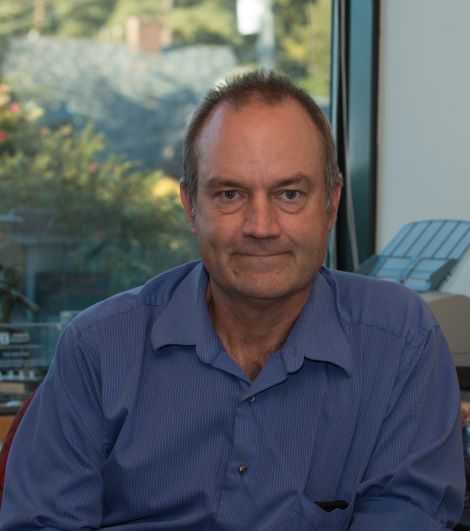
Paul and Stacy Jacobs Distinguished Professor of Engineering
637 Soda Hall, jfc a cs
Tel: (510)642-9955
Fax: (510)642-5615
Office hours:
MW 4:00-5:00pm
CS294-1:
Behavioral Data Mining
Courses from previous semesters Group Activities Paul Jacobs, 1989 (Qualcomm) last updated 10/1/10Current Research:

BID: The
Berkeley Institute of Design. BID is a new research program about
design in the era of pervasive technology. The BID lab is a 4000 sq ft
space in the Hearst Memorial Mining Building with researchers from CS,
ME, Education, Art Practice, SIMS and architecture. The program covers
activity-oriented design of workspaces, products and information
systems.

MILLEE:
Mobile and Immersive Learning for Literacy in Emerging Economies, aims
to improve "power language" literacy in developing regions. In
most developing regions, literacy is a major key to opportunity, and the
power language is often different from the learners first language.
School learning is often problematic and PCs are as yet rare in these
contexts, so MILLEE uses cell phones as the platform. MILLEE experiences
are game-like and support anytime/anywhere learning, even for children
who spend many hours a week working.

PACT
stands for Pattern-Annotated Course Tool. PACT is intended as a
fast-track to next-generation learner-centered courses. Learner-centered
classrooms are radically different from traditional ones, with learning
based on carefully crafted and organized activities. PACT exposes the
essential knowledge instructors need to create these courses through
pedagogical patterns. It supports authoring courses, customizing them
while preserving their pedagogical principles, and eventually the
creation and sharing of new pedagogical patterns.

Glaze
is developing design methods for location-based services. The goal is to
support rapid development and customization of location applications via
technology probes, using a simple noun-verb interface. Our
hypothesis is that LBSes should support small and large quanta of
functionality, and design methods should support both. We want to
support a flexible "design hierarchy" from originating
designer through other "customizers" through to the end
user.
SIMILE
is focused on natural speech interfaces for users in developing
regions. In this
project, we are developing a large-vocabulary, continuous speech
recognizer for smart phones to enable new forms of interaction. Our
first application is to speech-based language learning in the MILLEE
project. Beyond that we hope to explore localized services with maximum
economic impact in developing regions.

SmartSpace
uses audio information to localize users in the BID lab. A large array
of microphones in the ceiling provides a signal that is separated into
spatially distinct sources (usually people speaking in the room).
Eventually the goal is to use speech input from each source to drive a
recognizer which will allow voice commands to control the room. For now
it provides a real-time visualization of speaker location and
volume.

Health
Monitor: A wireless sensor for chronic and general wellness
monitoring. Collects traditional vital signs such as ECG, SPO2, temp, as
well as stress markers: EMG, GSR and movement. Designed to track chronic
conditions, support differential diagnosis, and to discover predictors
for a variety of health problems.
Archived Projects
Publications:
In reverse chronological order
Grouped by topic
Journals, Conferences and Workshops:
Editorial Board member for ACM Transactions on Computer-Human Interaction
EB member for IEEE Pervasive Computing Magazine
I was a program committee member for CHI
2005, CHI2007, CHI2008 and CHI2010
PC member for ICTD 2006, ICTD 2007, ICTD 2009, ICTD 2010
PC member for ACM DEV 2010
I organized the Mobile Applications Workshop
in May 2006 on the Berkeley campus.
Ubicomp Privacy Workshops: I co-organized workshops on Privacy at UBICOMP 2002,
2003, 2004 and 2005. The first workshop was titled Socially-Informed
Design of Privacy-Enhancing Solutions in Ubiquitous Computing, the second
was Ubicomp
communities: Privacy as boundary negotiation, the third was: Ubicomp
Privacy: Current status and future directions., and the fourth was Privacy
in Context.
Former Ph.D. Students
Greg Heinzinger, 1990 (Qualcomm)
Dinesh Manocha, 1992 (UNC)
Ming Lin, 1994 (UNC)
Ioannis Emiris, 1994 (University of Athens)
Aaron Wallack, 1995 (Cognex)
Ashu Rege, 1996 (NVidia)
Brian Mirtich, 1996 (Mathworks)
Yan Zhuang, 2000 (Qualcomm, number 3!)
Dan Reznik, 2000 (e-Solar)
Eric Paulos, 2001 (CMU)
Francesca Barrientos, 2002 (NASA)
Dan Glaser, 2004, (RPI)
Tom Duan, 2007, (Yodao, China)
David Nguyen, 2008, (Accenture)
Jeremy Risner, 2008, (e-Solar)
Ana Ramirez-Chang, 2008 (Oracle)
Matthew Kam, 2008 (CMU)
Tye Rattenbury, 2008 (Intel)
Jingtao Wang, 2010 (U. Pittsburgh)
Divya Ramachandran, 2010 (??)